
Unpacking the Roots of Indonesian Economic Sovereignty: A Collaborative Public Lecture with ANU and FEB UNHAS
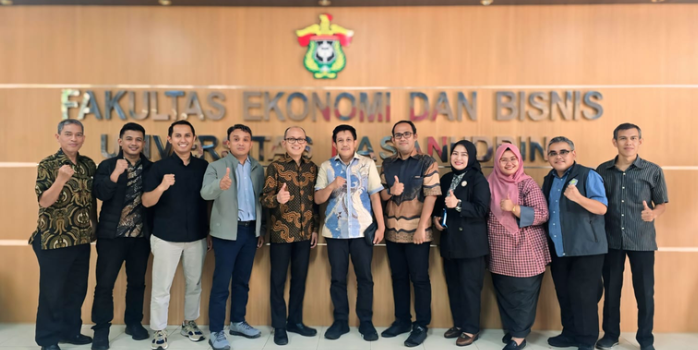
The Faculty of Economics and Business (FEB) at Hasanuddin University (UNHAS) recently served as a vibrant hub for intellectual discourse by hosting a public lecture featuring Dr. Arianto Patunru from the Australian National University (ANU) Indonesia Project. Held on Thursday, 5 February 2026, in the Senate Room, the event gathered a distinguished audience of lecturers alongside undergraduate and postgraduate students for an in-depth exploration of Indonesia’s fiscal identity. The lecture, titled “Nationalist Political Economy in Indonesia: History, Institutions, and Persistent Economic Nationalism,” provided a critical framework for understanding the ideological pillars that continue to define the nation’s economic landscape.
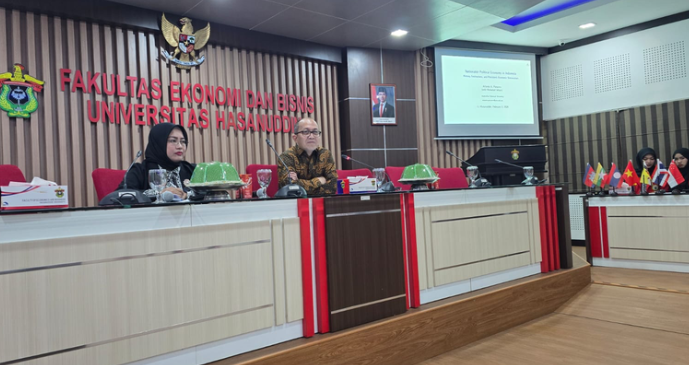
Dr. Patunru guided the audience through an analytical journey, beginning with the historical roots of Indonesian economic thought, which are deeply intertwined with the colonial struggle and the subsequent drive for total economic sovereignty. He emphasized how these historical sentiments were eventually codified into key institutions, most notably Article 33 of the 1945 Constitution, which mandates state control over vital resources for the collective welfare. By connecting past milestones to contemporary trends, the session illuminated why protectionist leanings often persist as a dominant policy preference, even in an era defined by global digital trade and international integration.
Central to the discussion was the observation that Indonesia’s economic trajectory is characterized by a persistent swing between liberal and protectionist policies. Dr. Patunru noted that the country does not adhere to a single consistent path; rather, it fluctuates between periods of high openness to global markets and phases of withdrawal where protectionist measures are implemented to shield domestic industries from foreign competition. This inconsistency is further complicated by the high prevalence of rent-seeking behavior, where business elites with close ties to political power seek to accumulate wealth through the manipulation of the economic and political environment. Instead of driving growth through innovation, these actors often rely on securing special licenses, monopolies, or import quotas that benefit a narrow group of interests.
These economic patterns are mirrored in a political landscape described during the lecture as a resilient yet flawed democracy. While Indonesia has successfully maintained its democratic framework since the Reformasi era, the system remains compromised by the influence of old-guard elites and interest coalitions. These forces often act as a barrier to the deep legal and economic reforms necessary for modernization. Furthermore, Indonesia’s economic identity is uniquely shaped by the political values of Pancasila. Rather than following a purely capitalist model of profit and loss, the nation emphasizes “People’s Economy” (ekonomi kerakyatan), a dominant role for the state via State-Owned Enterprises, and social justice principles that are frequently invoked to justify restrictions on foreign ownership and maintain nationalist control over resources.
The interactive nature of the event allowed for a robust exchange of ideas between the speaker and the FEB UNHAS academic community. Participants engaged in a high-level debate regarding the balance between maintaining a nationalist stance and the necessity of attracting foreign investment to fuel domestic growth. This dialogue underscored the importance of academic collaboration between UNHAS and the ANU Indonesia Project, highlighting a shared commitment to elevating local research through global scholarly engagement. The lecture concluded with a forward-looking perspective on how Indonesia might navigate its nationalist heritage while evolving within the complex web of modern international political economy.