
Anticipating the Climate Crisis, Research Collaboration between Unhas, the University of Melbourne, Unair, and Untad Strengthens Coastal Health System Resilience
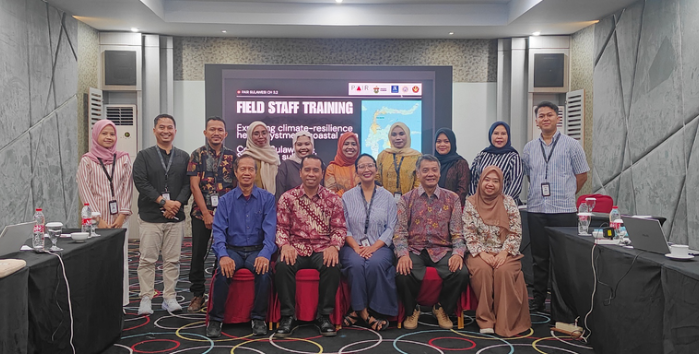
A strategic research consortium led by Hasanuddin University (UNHAS), in collaboration with The University of Melbourne, Universitas Airlangga (UNAIR), and Universitas Tadulako (UNTAD), has officially launched a major initiative to mitigate the impacts of climate change on the health sector. Under the Partnership for Australia–Indonesia Research (PAIR) framework, the four universities conducted an intensive training program for field research teams as part of the project titled “Exploring Climate-Resilient Health Systems in Coastal Areas.”
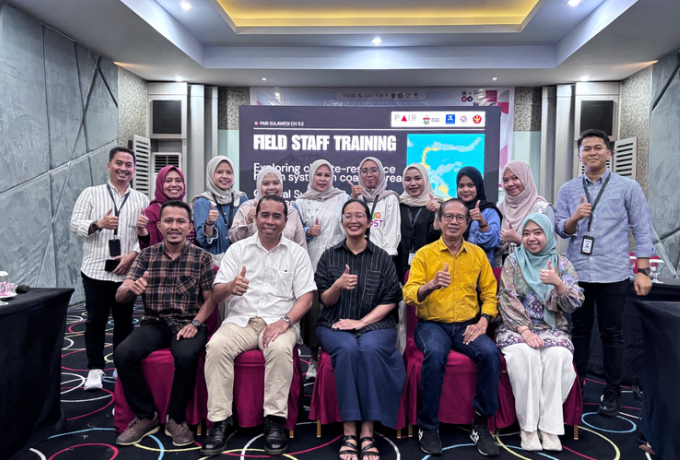
The three-day training, held from 7 to 9 January 2026 in Makassar, aimed to prepare researchers to assess the readiness of health facilities in six coastal districts across Central Sulawesi and Southeast Sulawesi in facing climate-related threats. In his opening remarks, the Principal Investigator of PAIR CH 3.2, Ansariadi, S.K.M., M.Sc.PH., Ph.D. from UNHAS, emphasized the urgency of the study by noting that Indonesia has the second-longest coastline in the world with a high concentration of coastal populations, raising a critical question of whether community health centers, hospitals, and the broader health system are resilient enough to withstand heatwaves, tidal flooding, and climate-induced disease outbreaks.
The involvement of UNTAD plays a key role in providing local contextual understanding in Central Sulawesi, while UNAIR and The University of Melbourne contribute strong expertise in health systems management and reinforce the project’s research methodology through international collaboration.
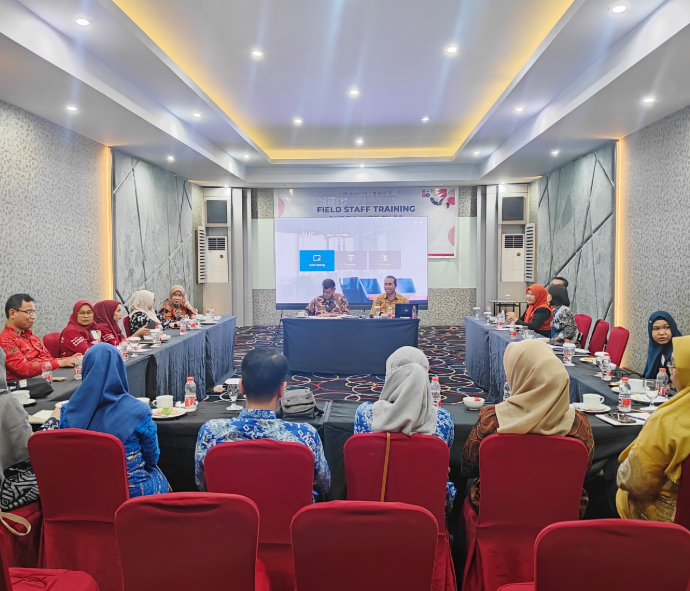
The training program began with an in-depth session delivered by Dr. drg. Setya Haksama, M.Kes. from UNAIR, who explained that future health system transformation must move in two directions simultaneously, namely building resilience to climate-related disasters while also reducing carbon emissions through low-carbon health system operations. This conceptual discussion was strengthened by presentations from the Central Sulawesi Provincial Health Office, which highlighted real challenges in the field, including the rising risk of vector-borne diseases and heat-related illnesses in coastal communities, as well as the importance of integrating the Climate-Healthy Village Program (DESI) with primary healthcare services at the puskesmas level.
To ensure the collection of valid and in-depth field data, Prof. Dr. Suriah, SKM., M.Kes., Professor in the Department of Health Promotion and Behavioral Sciences at UNHAS, provided focused training on qualitative research methods. She underlined that coastal communities face unique vulnerabilities and that researchers need not only quantitative data, but also a human-centered and ethical approach to capture the lived experiences of communities affected by climate change. This session was followed by a research instrument validation process involving heads of community health centers and health workers, ensuring that the research questions were aligned with real operational conditions in coastal health facilities.
As the final component of the training, Dr. Ariane Utomo, Co-Lead Researcher from The University of Melbourne, introduced an innovative visual research approach using a photo diary method, explaining that photography can serve as a powerful research evidence tool to visually document how the physical infrastructure of community health centers either withstands or remains vulnerable to climate change impacts in coastal areas, offering perspectives that are often overlooked in written reports.
The findings from this collaborative research are expected to produce policy briefs to be submitted to both local and national governments, as well as to support the development of training modules aimed at strengthening climate resilience within Indonesia’s national health system. The project is implemented under the PAIR, a bilateral initiative supported by the Governments of Indonesia and Australia to address key policy challenges through collaborative, evidence-based research, with PAIR Sulawesi jointly funded by the Government of Indonesia through the Ministry of Higher Education, Science, and Technology and Lembaga Pengelola Dana Pendidikan (LPDP) or Indonesian Education Endowment Fund), and by the Government of Australia through Department of Foreign Affairs and Trade (DFAT).