
Learning Amid the Karst: Experiences of Chinese Students with Rumah Belajar Anak Sungai
Rammang-Rammang, a renowned karst region in Maros Regency, served as the field trip destination for a group of Chinese students currently studying in the Department of Indonesian Literature on Saturday, 29 November 2025. The activity was originally designed to explore the karst landscape and the social dynamics of the local community, but it developed into a much more meaningful learning experience. Accompanying the students were lecturers such as Dr. Muslimat, M.Hum. (Head of Indonesian Literature Study Program) and Dr. Indarwati, S.S., M.Hum (Secretary of Indonesian Literature Study Program) and were assisted by the student volunteers including Ipah Bahya, S.S., M.A. and Anita Damayanti, S.S., M.A.
Upon arriving in Salenrang Village, the group visited Rumah Belajar Anak Sungai, a community education center pioneered by Muhammar Ikhwan, also known as Iwan Bento. The center has long functioned as a learning and empowerment space for children and local residents through non-formal education programs integrating social, cultural, and environmental aspects. The students joining the event were Yang Yujie, Ge Huijie, Fang Min, Chen GUO, Li Yuxin, Chen Hong, Wu Suyan, Xu Xinlei, Sun Jingyuan, Jing Chunlu, Cui Xinyue, Ding Ruixin, Shen Yiang.
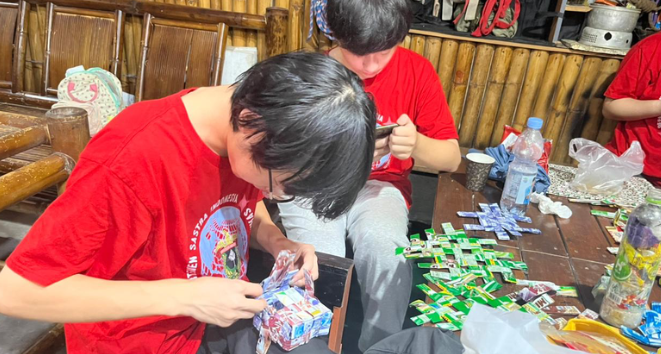
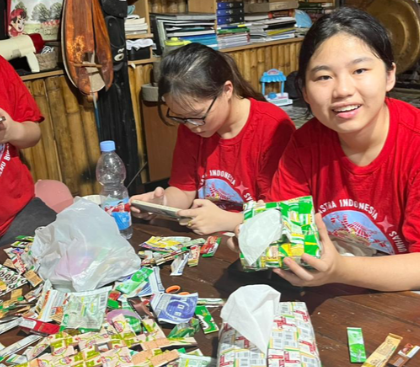
The students observed a variety of activities, including dance classes, Qur’an recitation, environmental discussions, and life skills development through English lessons and craft training. One program that particularly captured their interest was women’s empowerment through the creation of recycled crafts from plastic packaging waste, which are functional and support household income.
The students participated directly in the process of making bags, table mats, and tissue holders from used plastic wrappers. Warm interactions occurred despite language barriers, and they expressed great appreciation for the community’s creativity in transforming waste into valuable products, showcasing perseverance and strong commitment to community empowerment.
Through this visit, the students gained new insights into how community-based education and consistent small actions can drive social change. The field experience became a valuable lesson on cultural collaboration, creativity, and sustainability—surpassing the boundaries of a traditional classroom setting.